

Definition:
A function \(f(x)\) is continuous at a given point x = a if those three conditions below are met “simultaneously”:
(i) \(f(a)\) is defined. (i.e; a is in the domain of \(f\))
(ii) \(\lim\limits_{x \to a} f(x)\) exists.
(iii) \(\lim\limits_{x \to a} f(x) = f(a).\)
NOTE:
- If any one of the three conditions is false, then \(f\) is discontinuous at a, or it has a discontinuity at a.
Let’s now look at the different cases where \(f(x)\) may not be continuous at x = a.
(i) \(f(a)\) is defined but \(\lim\limits_{x \to a} f(x)\) does not exist.
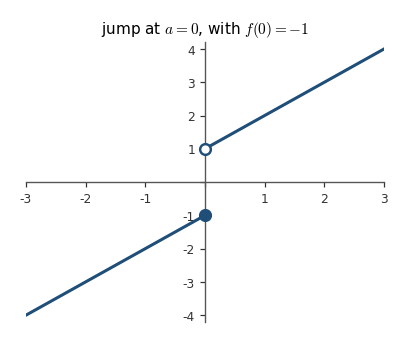
At a = 0, the function is not continuous despite \(f(a)\) is defined (Here, \(f(a)\) is equal to -1). This is because the two one-sided limits are not equal and as a consequence, the limit does not exist. This is called a jump discontinuity.
(ii) \(\lim\limits_{x \to a} f(x)\) exists, but \(f(a)\) is not defined.
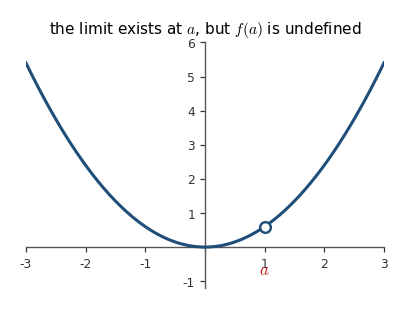
Assume a is the x-value where there is a hole in the graph. We can see that the limit from the right of a and the limit from the left of a are equal. Therefore, the limit exists. However, \(f\) is undefined at a. This is another form of discontinuity, and it known as a removable discontinuity.
(iii) \(f(a)\) is defined, \(\lim\limits_{x \to a} f(x)\) exists, but \(\lim\limits_{x \to a} f(x) \neq f(a).\)
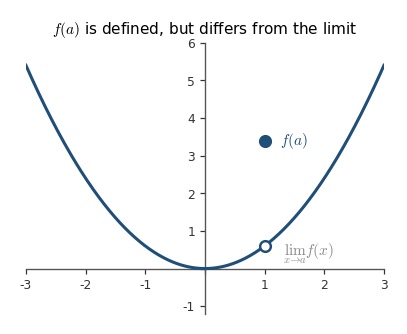
Assume a is the x-value where there is a hole in the graph. This one is also an example of removable discontinuity. However, there is a slight difference:
Here \(f(a)\) is defined and \(\lim\limits_{x \to a} f(x)\) exists. The reason for the discontinuity is because \(\lim\limits_{x \to a} f(x) \neq f(a).\)
We have seen different examples of how a function depends on the conditions for it to be continuous. If one of the conditions fail, the function is discontinuous.
Let’s now work through some examples.
E.g; (a) Given the graph of \(f(x)\), determine if \(f(x)\) is continuous at x = -4, x = -1, x = 2 and x = 4.
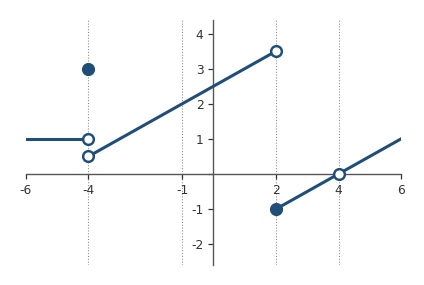
(i) At x = -4, \(f(-4)\) is defined and is equal to 3. However, \(\lim\limits_{x \to -4^{+}} f(x) \neq \lim\limits_{x \to -4^{-}} f(x)\). Or, in simple terms the limit as x approaches -4 from the left is not equal to the limit as x approaches -4 from the right. Therefore, the function has a discontinuity at the point x = -4.
(ii) Now, at x = -1, we see that \(f(-1)\) is defined, the \(\lim\limits_{x \to -1^{+}} f(x) \equiv \lim\limits_{x \to -1^{-}} f(x)\) and \(\lim\limits_{x \to -1} f(x) \equiv f(-1)\). We can say that the function is continuous at x = -1.
(iii) When x = 2, \(f(2)\) is defined and is equal to -1. However, the limit as x approaches 2 from the left is not equal to the limit as x approaches 2 from the right. Clearly, one of the conditions has failed. Hence, we know that \(f\) is not continuous at x = 2.
(iv) At x = 4, despite \(\lim\limits_{x \to 4^{+}} f(x) \equiv \lim\limits_{x \to 4^{-}} f(x)\), \(f(4)\) is undefined. Therefore, the function is discontinuous at x = -4.
(b) Given the graph of \(f(x)\), determine if \(f(x)\) is continuous at x = -8, x = -2, x = 6 and x = 10.
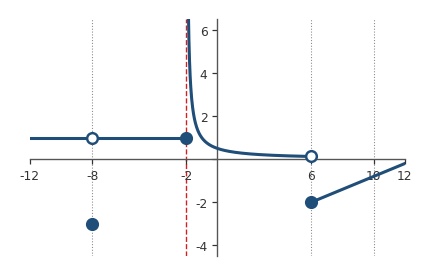
(i) At x = -8, it is clear that \(f(-8)\) is defined and \(\lim\limits_{x \to -8^{+}} f(x) \equiv \lim\limits_{x \to -8^{-}} f(x)\). However, \(\lim\limits_{x \to -8} f(x) \neq f(-8)\) as \(f(-8)\) is equal to -3. Therefore, the graph is discontinuous at x = -8.
(ii) Now, at x = -2, we can see that \(f(-2)\) is defined, but \(\lim\limits_{x \to -2^{+}} f(x) \neq \lim\limits_{x \to -2^{-}} f(x)\). In fact, we can say that \(\lim\limits_{x \to -2^{-}} f(x) \equiv f(-2)\) and \(\lim\limits_{x \to -2^{+}} f(x) = \infty\). As the right-sided limit and the left-sided limit are not equal, the graph has a discontinuity at x = -2.
(iii) When x = 6, \(\lim\limits_{x \to 6^{+}} f(x) \neq \lim\limits_{x \to 6^{-}} f(x)\). Even though \(f(6)\) is defined, the function is not continuous here either, at x = 6.
(iv) At x = 10, \(f(10)\) is defined, \(\lim\limits_{x \to 10^{+}} f(x) \equiv \lim\limits_{x \to 10^{-}} f(x)\) and \(\lim\limits_{x \to 10} f(x) = f(10)\). Therefore, we can conclude that it is continuous at this point.


If a function has a removable discontinuity at a point, is it defined at that point? If not, then is the function not continuous on its domain?
It can be defined at that point, but may not necessarily be continuous from the left or from the right as x approaches that point. That is, it can be defined and not equal to the limit from the right or from the left.
Absolutely right! If it is not defined, then the function is not continuous on its domain.
Ah, interesting, Aidan. I believe it is continuous on it’s domain then, since it’s domain specifically excludes that point where the discontinuity is. Ironic. But I see Wikipedia says our flippant use of “discontinuity” outside of the domain is an “abuse of terminology”. Our textbook doesn’t care about the difference though.
[…] Continuity – part 1 […]
Revisiting this, I agree with Jean-Jacq in that functions can be continuous on their domain, even if they are discontinuous on R. For example, the tangent function is continuous wherever it is defined. That notion may seem foreign to a first-year student, because it was not taught to me in MAM1000W.
Read this page from Mícheál Ó Searcóid’s textbook ‘Metric Spaces’: http://i.stack.imgur.com/pwQuk.jpg