About Azhar Rohiman

I'm a student at the University of Cape Town, currently studying Computer Science and Mathematics.

Chain Rule.

Definition:

The chain rule is a method for differentiating a function of a function, or differentiating composite functions.

Consider the expression \(y = sin(x^2)\). We notice that this is not a normal sine function. It has an \(x^2\) as argument for the sine function. Therefore, we can consider the \(x^2\) in the sine function as a whole different function. This can be broken into two functions, \(f(x)\) and \(g(x)\).

If we consider \(f(x) =  sin(x); g(x) = x^2\), we can write \(y = f(g(x))\).

In order to differentiate a composite function, \(y = f(g(x))\), i.e; to find \(y'\), we let

\(u = g(x)\)  and  \(y = f(u)\)

What this implies is that whatever \(g(x)\) is, u will be equal to that. Then, the process of differentiating is to find

  • \(\frac{du}{dx}\) (as u will be a function of x).
  • \(\frac{dy}{du}\)

Finally, we can write,

\[\frac{dy}{dx} = \frac{dy}{du} \cdot \frac{du}{dx}\]

Back to our example, \(y = sin(x^2)\); remember that \(f(x) = sin(x)\) and \(g(x) = x^2\). We let

\(u =  x^2\)  and  \(y = f(u) = sin(u)\)

Therefore,  \(\frac{du}{dx} = 2x\) and  \(\frac{dy}{du} = cos(u)\)

This leaves us with  \(\frac{dy}{dx} = cos(u) \cdot 2x\). We can simplify the equation by writing

\[\frac{dy}{dx} = 2xcos(x^2)\]

Note that the u in the cosine function is replaced with \(x^2\).…
By | April 29th, 2016|Courses, First year, MAM1000, Undergraduate|0 Comments

Continuity – (Part Two).

Definition:

(i) A function \(f\) is said to be continuous from the right at a if

\[\lim\limits_{x \to a^{+}} f(x) = f(a)\]

Right

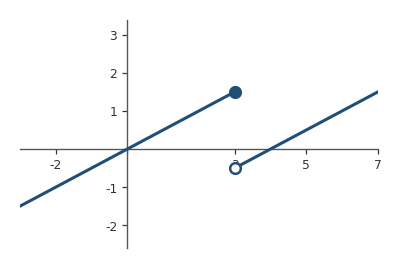
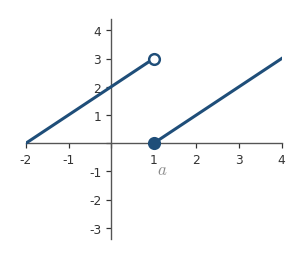
We can see that, as the function approaches a certain x-value from the right, \(f\) is defined and

\[\lim\limits_{x \to a^{+}} f(x) \equiv f(a)\]

And as the function approaches a certain x-value from the left, \(f\) is not defined, i.e;

\(\lim\limits_{x \to a^{-}} f(x) \neq f(a)\).

Therefore, we say that the function is continuous from the right at this point, but is discontinuous from the left.

(ii) A function \(f\) is said to be continuous from the left at a if

\[\lim\limits_{x \to a^{-}} f(x) = f(a)\]

Left

Here, it is clear from the graph that the function is continuous from the left as x approaches 3. This is because the function is defined at x = 3 and,

\[\lim\limits_{x \to 3^{-}} f(x) \equiv f(3)\]

However, from the right,

\[\lim\limits_{x \to 3^{+}} f(x) \neq f(3)\]

So, we can say that the function is continuous from the left, but discontinuous from the right, at the point x = 3.

We may also have a function where it is neither continuous at a point from the left or from the right but is defined elsewhere.…

By | March 31st, 2016|Courses, First year, MAM1000, Undergraduate|3 Comments

Continuity – (Part One).

Definition:

A function \(f(x)\) is continuous at a given point x = a if those three conditions below are met “simultaneously”:

(i) \(f(a)\) is defined. (i.e; a is in the domain of \(f\))

(ii) \(\lim\limits_{x \to a} f(x)\) exists.

(iii) \(\lim\limits_{x \to a} f(x) = f(a).\)

NOTE:

  • If any one of the three conditions is false, then \(f\) is discontinuous at a, or it has a discontinuity at a.

Let’s now look at the different cases where \(f(x)\) may not be continuous at x = a.

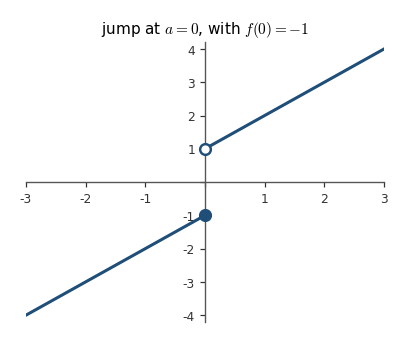
(i) \(f(a)\) is defined but \(\lim\limits_{x \to a} f(x)\) does not exist.

JumpDiscontinuity

At a = 0, the function is not continuous despite \(f(a)\) is defined (Here, \(f(a)\) is equal to -1). This is because the two one-sided limits are not equal and as a consequence, the limit does not exist. This is called a jump discontinuity.

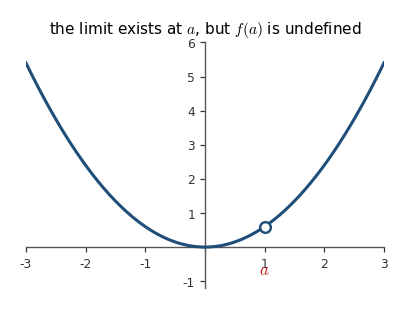
(ii)  \(\lim\limits_{x \to a} f(x)\) exists, but \(f(a)\) is not defined.

RemovableDiscontinuity

Assume a is the x-value where there is a hole in the graph. We can see that the limit from the right of a and the limit from the left of a are equal.…

By | March 31st, 2016|Courses, First year, MAM1000, Uncategorized, Undergraduate|5 Comments