Continuity – (Part Two).
Definition:
(i) A function \(f\) is said to be continuous from the right at a if
\[\lim\limits_{x \to a^{+}} f(x) = f(a)\]
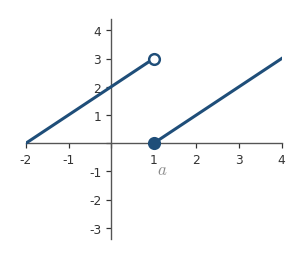
We can see that, as the function approaches a certain x-value from the right, \(f\) is defined and
\[\lim\limits_{x \to a^{+}} f(x) \equiv f(a)\]
And as the function approaches a certain x-value from the left, \(f\) is not defined, i.e;
\(\lim\limits_{x \to a^{-}} f(x) \neq f(a)\).
Therefore, we say that the function is continuous from the right at this point, but is discontinuous from the left.
(ii) A function \(f\) is said to be continuous from the left at a if
\[\lim\limits_{x \to a^{-}} f(x) = f(a)\]
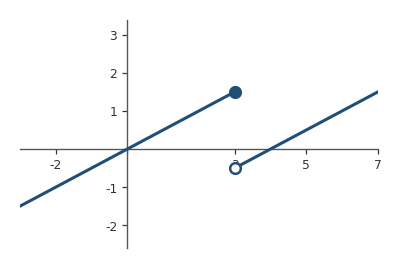
Here, it is clear from the graph that the function is continuous from the left as x approaches 3. This is because the function is defined at x = 3 and,
\[\lim\limits_{x \to 3^{-}} f(x) \equiv f(3)\]
However, from the right,
\[\lim\limits_{x \to 3^{+}} f(x) \neq f(3)\]
So, we can say that the function is continuous from the left, but discontinuous from the right, at the point x = 3.
We may also have a function where it is neither continuous at a point from the left or from the right but is defined elsewhere.…