

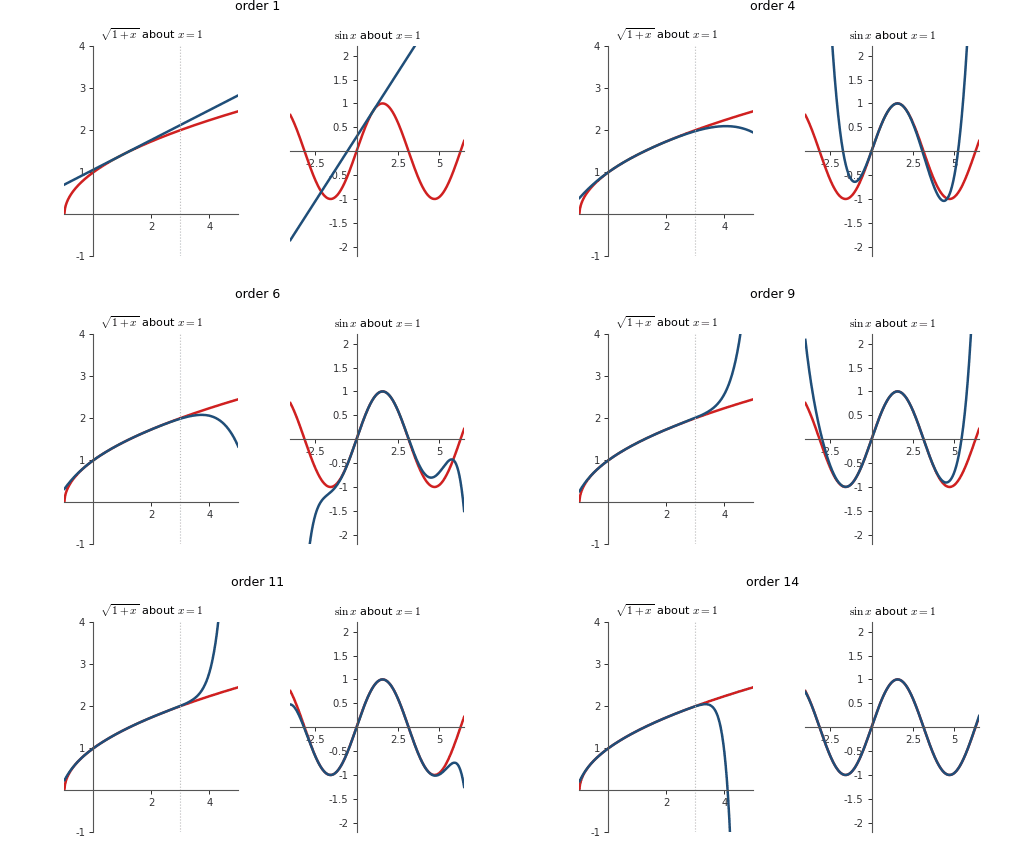
I hinted today that there were sometimes issues when you did a polynomial approximation, that if you tried to find the value of a function a long way from the region about which you’re approximating, that sometimes you wouldn’t be able to do it. This is related to an idea called the radius of convergence of a series. In the following we are just plotting polynomials, but you can see that whereas in the polynomial approximation for sin(x) (on the right), as we get more and more terms, we approximate the function better and better far away from the point x=1 (which is the point about which we are approximating the function). However, for the function \(\sqrt{1+x}\), after x=3, the approximations are nowhere near the function itself. This is because that function has a radius of convergence of 2, when expanded about x=1. This is due to the behaviour of the function at x=-1, which is a distance 2 away. However many terms we take, we can never approximate the function well past x=3 if we expand about x=1.


Leave a Reply