

So, in the last post we had seen that while the sin function is not one-to-one and thus doesn’t have an inverse, so long as we restrict it to a given domain, you will find that it is invertible. The domain that we found (indeed chose), was between \([-\frac{\pi}{2},\frac{\pi}{2}]\). It’s inverse was a function with domain \([-1,1]\). The name of the inverse is arcsin(x). How can we use this to help us to solve problems?
Well, what if I asked you to solve:
\[sin(x)=\frac{1}{2}\]
You might think that because we have found the inverse of sin, that we can simply say that the solution to this is:
\[x=arcsin\frac{1}{2}\]
Well, because arcsin is itself a one-to-one function, restricted to the domain \([-1,1]\) this will clearly give us a single number (the answer is about 0.52):
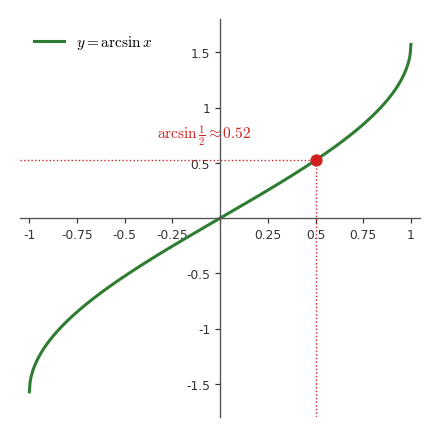
Is that it then? Well, let’s look at the graph of sin(x) and see if this is the only solution to \(sin(x)=\frac{1}{2}\):
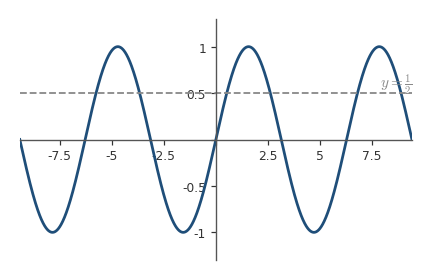 In fact, clearly there are an infinite number of solutions to the equation \(sin(x)=\frac{1}{2}\) and we have just caught the one within the region \([-\frac{pi}{2},\frac{\pi}{2}]\). What are the other solutions. Well, we see that there are also solutions separated by \(2 \pi\). These are shown in the following plot (the original solution we found is the first red dot to the right of the y-axis):
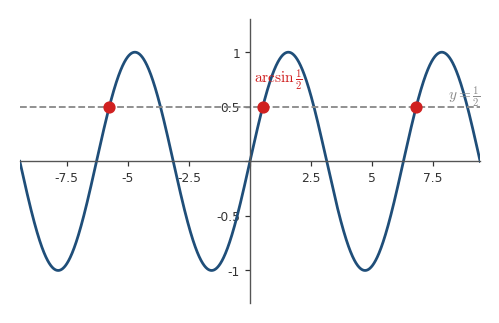
These can be written as:
\(\arcsin(\frac{1}{2})+2\pi k\) with \(k\in \mathbb{Z}\).
However, it is clear that there are some more solutions that we haven’t captured. How could we write the point shown in green in terms of \(\arcsin(\frac{1}{2})\)?
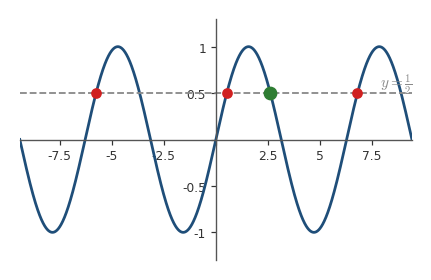
Let’s zoom into that one green point, and figure out how it relates to \(\arcsin(\frac{1}{2})\) – the red point below:
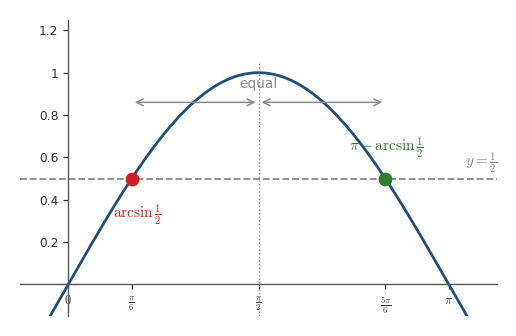 So if this point can be written in terms of \(arcsin(\frac{1}{2})\), then so can all the other points separated from the green point by intervals of \(2\pi\). These are given by:
\(\pi-\arcsin(\frac{1}{2})+2\pi k\) with \(k\in\mathbb{Z}\).
So, altogether, the solutions to the equation \(sin x=\frac{1}{2}\) are given by:
\(\arcsin(\frac{1}{2})+2\pi k\) and \(\pi-\arcsin(\frac{1}{2})+2\pi k\) with \(k\in\mathbb{Z}\).


[…] Can we find the inverse of a function which is not one-to-one? – part 2 […]