

Can we find the inverse of a function which is not one-to-one? (part two)
So, in the last post we had seen that while the sin function is not one-to-one and thus doesn’t have an inverse, so long as we restrict it to a given domain, you will find that it is invertible. The domain that we found (indeed chose), was between \([-\frac{\pi}{2},\frac{\pi}{2}]\). It’s inverse was a function with domain \([-1,1]\). The name of the inverse is arcsin(x). How can we use this to help us to solve problems?
Well, what if I asked you to solve:
\[sin(x)=\frac{1}{2}\]
You might think that because we have found the inverse of sin, that we can simply say that the solution to this is:
\[x=arcsin\frac{1}{2}\]
Well, because arcsin is itself a one-to-one function, restricted to the domain \([-1,1]\) this will clearly give us a single number (the answer is about 0.52):
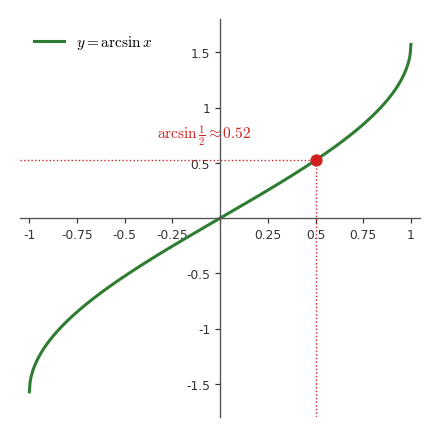
Is that it then? Well, let’s look at the graph of sin(x) and see if this is the only solution to \(sin(x)=\frac{1}{2}\):
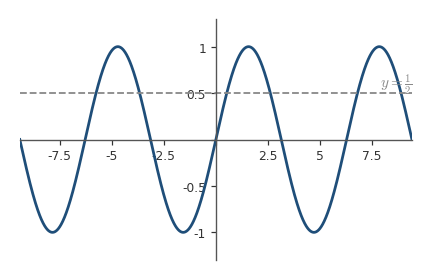 In fact, clearly there are an infinite number of solutions to the equation \(sin(x)=\frac{1}{2}\) and we have just caught the one within the region \([-\frac{pi}{2},\frac{\pi}{2}]\).…


