About Aidan Horn

I study Maths, Economics and Public Policy & Administration at UCT.

Convex functions

What I learnt in class today:

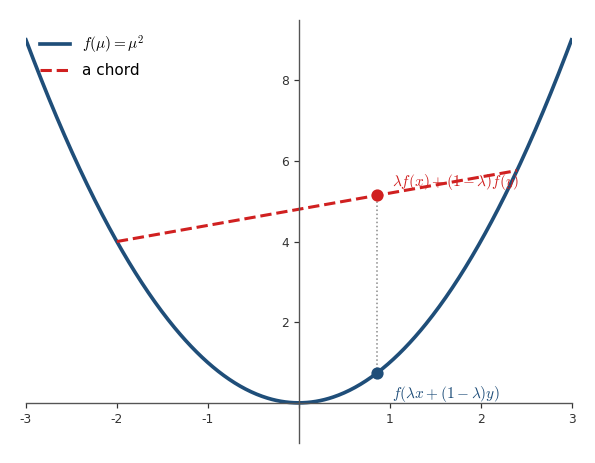
A convex function \(f:\mathbb R\to\mathbb R\) is defined as satisfying

\(f(\lambda x + (1-\lambda )y)\leq \lambda f(x)+(1-\lambda )f(y) \quad \forall x,y\in \mathbb R,\ \forall \lambda \in [0, 1].\)


Thus, the shape of a convex function is like \(\smallsmile\) . An example of a convex function is f(μ)=μ2:
 

How clear is this post?
…
By | August 15th, 2016|Uncategorized|0 Comments

The confusion about discontinuity

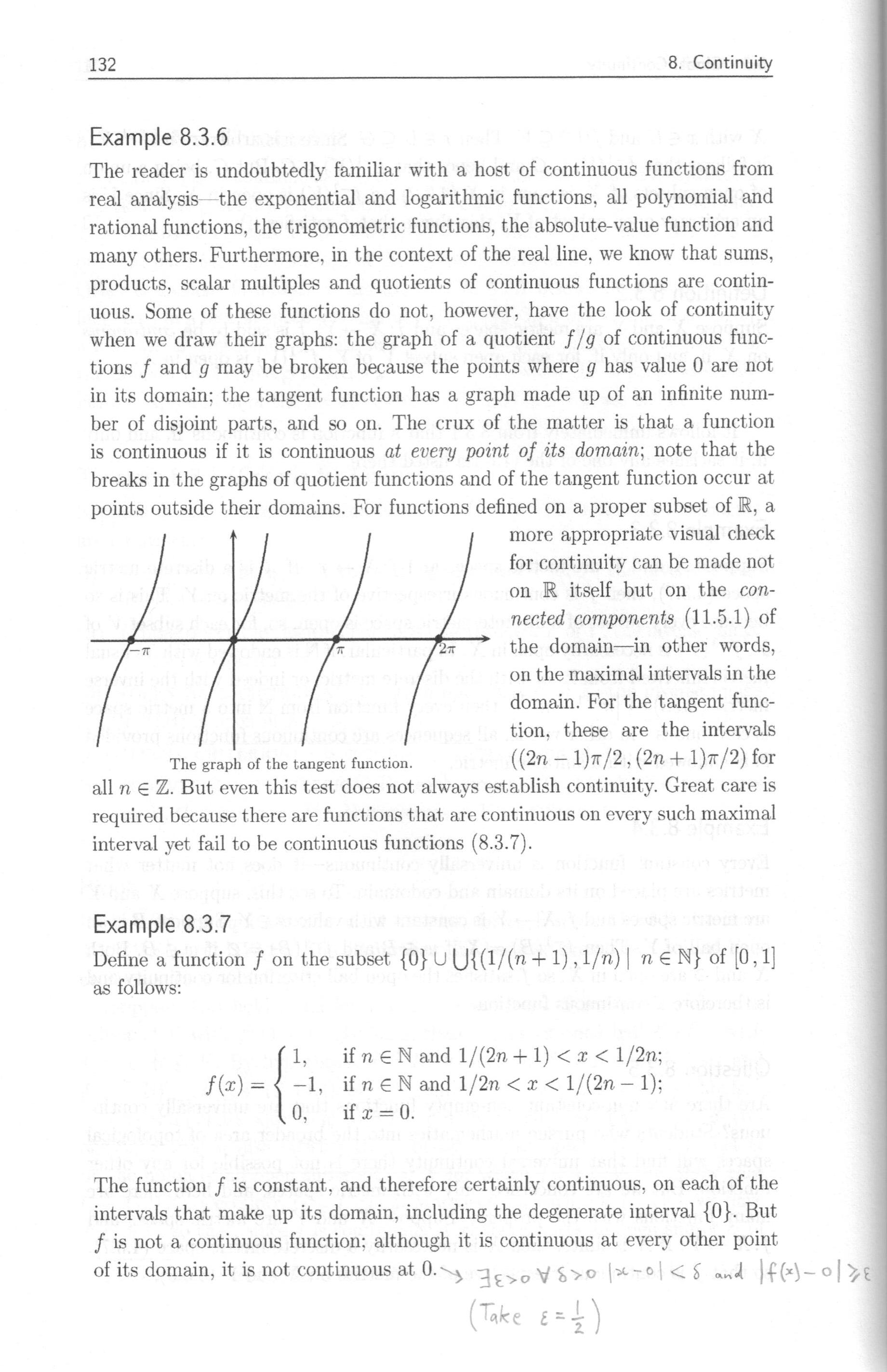
Whilst reading Mícheál Ó Searcóid’s book Metric Spaces, I found out about a nuance in the definition of continuity that I was not previously aware of, and something which may be taught incorrectly at high schools. M. Searcóid states that a function such as tan(x) is continuous (read the page here). The definition of continuity at a point is based on the fact that the function has a value at that point (if a function is continuous at x = a, then f(a) has a value in the expression |f(x)-f(a)|<ϵ). However, following M. Searcóid’s line of thought about continuous functions, it does not make sense to consider points at which a function is not defined. If we were asked to prove that the function is ‘discontinuous’ at a point, we would need to show that the condition for continuity at that point is false. And the negation* of the condition for continuity would not make sense at a point where the function value is not defined.…

By | July 21st, 2016|Courses, Level: intermediate|2 Comments

Mathematically speaking, what is a contradiction?

The world of predicate logic interests me, especially how it provides a foundation for understanding the logic behind many mathematical proofs. It is interesting to know how the negation, contrapositive and inverse are defined with respect to some implication \(A \Rightarrow B\)   (\(A \wedge \neg B, \neg B \Rightarrow \neg A\)  and  \(B \Rightarrow A\) respectively). What got me thinking about predicate logic again was when I asked myself, “What is a contradiction?”

My big Collins Dictionary and Thesaurus defines ‘contradict’ as “to declare the opposite of (a statement) to be true” (verbatim). But, this leaves some room for debate as the meaning of the word “opposite” is not logically clear. Is the negation true? Is the inverse true? My reasoning says that a contradiction of the above implication is defined as \(A \Rightarrow \neg B\). In a less formal way (and also less strongly), \(A \not \Rightarrow B\).

Let me briefly pause here for the sake of those unfamiliar with the symbols I have already used. \(\neg\) denotes ‘not’, \(\Rightarrow\) denotes ‘implies’, \(\wedge\) denotes ‘and’, and A and B are symbols which represent a statement, such as “dogs are black” or “black animals are dogs”.…

By | November 1st, 2015|Level: Simple, Uncategorized|1 Comment

An explanation for the multiplier effect in a Keynesian macroeconomic model

In this post I will provide a mathematical basis for the multiplier effect which is found when changing an autonomous variable in the aggregate expenditure function (AE). AE is a function which represents the total amount of money that is spent by all consumers in an economy, and is made up of two components: autonomous expenditure (which is exogenous in relation to income) and induced expenditure (endogenous to income). In other words, autonomous expenditure is the y-cut of the AE funtion, and any increases in autonomous expenditure will shift AE vertically. Induced consumption refers to any expenditure that is over and above the level of expenditure at the y-cut, and is directly related to the gradient of the AE function (which includes the marginal propensity to consume¹). Referring to Figure 1 below, let the increase in autonomous expenditure be y1. y1 thus shifts AE1 to AE2.…

By | March 15th, 2015|English, Level: intermediate|4 Comments

The domain of a composite function

In this article I outline a systematic way of finding the domain of a composite function. A definition that can be used for this purpose follows:

\[D(f \circ g) = \{x|x\in D(g) \wedge g(x) \in D(f)\}\]

(Vaught, 1995:18)

Where \(D(\lambda) =\)  \(\text{the domain of }\lambda\)

The explanatory method which follows is to show how to use this definition in different examples.

Example 1

Solve \(D(\ln(\ln(\ln x)))\) .

Solution:

Let \(\ln(\ln(\ln x)) = f(g(h(x)))\)

\[\begin{align*} \text{Firstly, }& D(g\circ h) = \{x|x\in (0,\infty)\wedge \ln x\in (0,\infty)\} \\ & \ln x\in (0,\infty) \Leftrightarrow x\in (1,\infty) \\ \therefore \; \; & D(g\circ h) = x \in (1, \infty) \\ ~\\ \text{Now, }& D(f \circ (g\circ h)) = \{x|x\in (1,\infty)\wedge \ln(\ln x)\in (0,\infty)\} \\ & \ln(\ln x)\in (0,\infty) \Leftrightarrow \ln x\in (1,\infty) \Leftrightarrow x \in (e,\infty) \\ \therefore \; \; & D(f \circ g\circ h) = x \in (e, \infty) \end{align*}\]

\[\square\]

Example 2.1

Let \(f(x)=x+1\) and \(g(x)=x^2\) where \(D(g)=[-2,2]\).

Find \(D(f\circ g)\)

Solution:

\(\begin{align*} f\circ g(x) &= x^2+1 \\ D(f\circ g) &= \{x|x \in [-2,2] \wedge x^2 \in \mathbb{R} \} \\ & x^2 \in \mathbb{R} \Leftrightarrow x \in \mathbb{R} \\ \therefore \; \; & x \in [-2,2] \end{align*}\)

\[\square\]

Example 2.2

Consider the same constraints as in Example 2.1, but with \(D(f)=[-2,1]\)

Solution:

\(\begin{align*} D(f\circ g) &= \{x|x \in [-2,2] \wedge x^2 \in [-2,1] \} \\ & x^2 \in [-2,1] \Leftrightarrow x^2 \in [0,1] \Leftrightarrow x \in [-1,1] \\ \therefore \;\; & x \in [-1,1] \end{align*}\)

\[\square\]

References

Vaught, RL. 1995. Set theory: An introduction. 2nd edition. Boston: Birkhäuser.


LaTeX and PDF format here

How clear is this post?
…
By | March 4th, 2015|English, Level: intermediate, Uncategorized|0 Comments