An oddly intuitive method to finding the distance between two skew lines in 3 space.
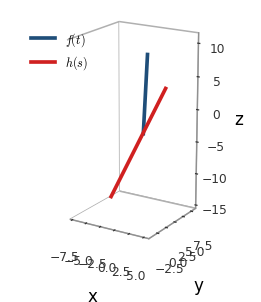
We begin by considering two lines. Namely, \(f(t): x = 1 + 2t, y = 2 - 3t, z = 3 + 4t\) and \(h(s): x = -1 + 3s, y = 3-s, z = -5 + 5s\). I now plot these two lines in 3 space in order to justify their skewness i.e. They do not intersect and are not parallel.
I now introduce a new function \(D_l\) and this is defined as the distance between the two lines i.e. \(|(f(t)-h(s)|\). We now work with this equation to derive a general method for calculating the distance between two skew lines.
Before we begin, recall that \(|{(a,b,c)}| = \sqrt{a^2+b^2+c^2}\)
Now,
\[D_l = |{(1,2,3)-(-1,3,-5)+t(2,-3,4)-s(3,-1,5)}| \\= |{(2 + 2t - 3s, -1 -3t + s, 8 + 4t -5s)}| \\= \sqrt{(2+2t-3s)^2+(-1 -3t+s)^2+(8+4t-5s)^2}\\=\sqrt{35s^2 - 58st - 94s + 29t^2 + 78t + 69}\]
I now bring in some Calculus. We use the fact that minimizing a function is the same as minimizing the square of that function (does not always hold but it holds here because we are dealing with a distance function that is non-negative and monotonic). Hence, we do the following:
\[(D_l)^2 = 35s^2 - 58st - 94s + 29t^2 + 78t + 69\]
We now take the partial derivatives \((D_l)^2\) with respect to s and t and we set it equal to zero. This is as follows.
\[\frac{\partial (D_l)^2}{\partial s} = 70s -58t -94 = 0\]
\[\frac{\partial (D_l)^2}{\partial t} = -58s+58t+78 = 0\]
Solving the system of linear equations we arrive at \(s=\frac{4}{3}\) and \(t=\frac{-1}{87}\).…